Return to industrial accidents
Download REPPIR Prior Information BookletThis page gives advice on what to do in the event of a radiation emergency at the Rolls-Royce Submarines Ltd (RRSL), Raynesway site.
Detailed Emergency Planning Zone
On receipt of a notification of emergency event at Rolls-Royce Submarines Ltd (RRSL), Raynesway site and you are within the Detailed Emergency Planning Zone (DEPZ) follow the advice detailed for each area below:
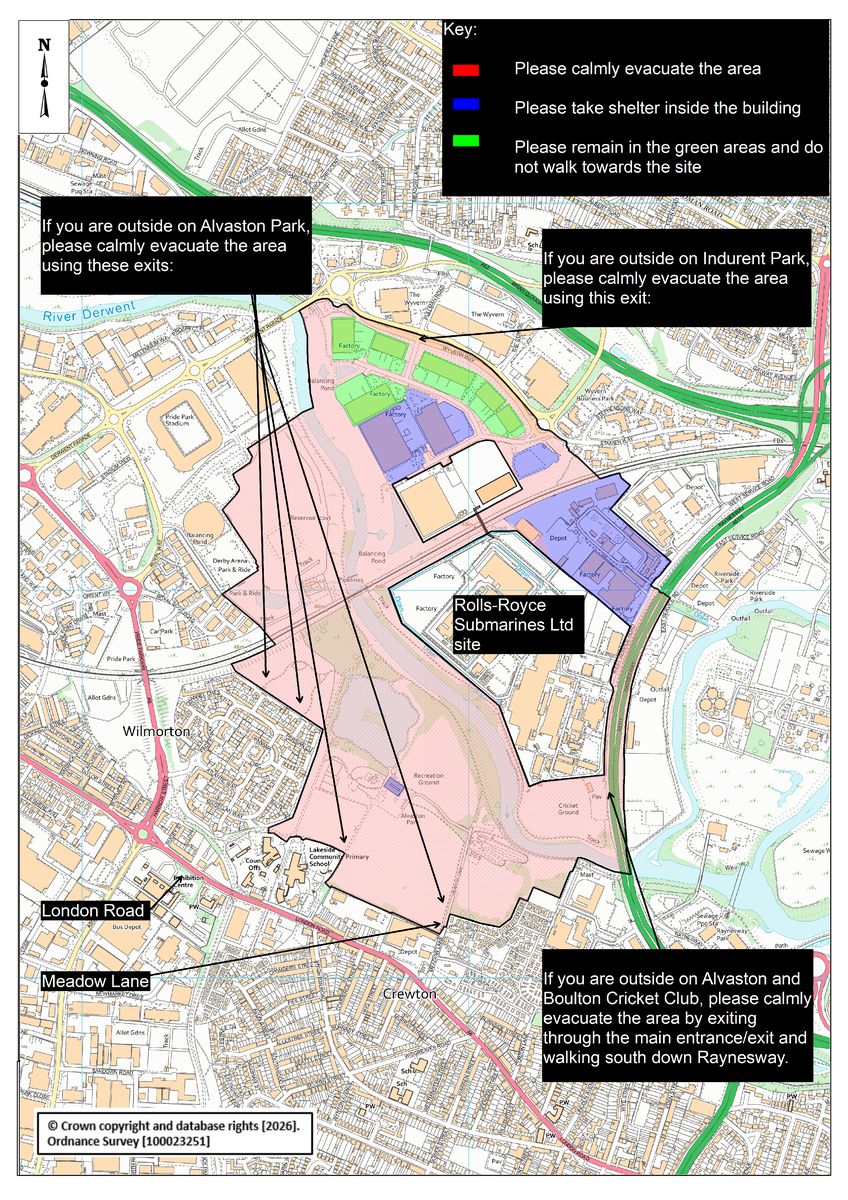 View larger
If you are outside within the detailed emergency planning zone:
Receipt of the emergency alert should be the activation for evacuating the area (if you are outside within the DEPZ). Please follow the instructions given to you by police, including on where you are being evacuated to. Anyone outside including on Indurent Park, Alvaston & Boulton Cricket Club, or Alvaston Park, should evacuate the area calmly by moving away from the site. Exit routes are shown on the map above.
If you are exiting Alvaston Park:
- please use the Meadow Lane exit, or
- one of the footpaths which exit towards London Road.
If you are exiting Indurent Park:
- please leave via the exit to the north.
If you are exiting Alvaston & Boulton Cricket Club:
- please use the main entrance/exit and walk south down Raynesway
If you are exiting any other area of the DEPZ:
- please walk calmly away from the site
If you are a business within the DEPZ:
Advice for those taking shelter (shaded blue on the map):
- keep all the doors and windows closed
- move away from windows
- turn off air conditioning
- find a safer place inside such as a corridor or windowless room or a room facing away from the site
- keep up to date with messages on Derby City Council’s website and Derbyshire Constabulary’s Facebook page.
- keep the mobile phone with you that you have been contacted on by the local authority.
Advice for those evacuating (shaded red on the map):
- leave the building you are in as soon as possible and use a door that leads away from the site
- use your building evacuation plan if you have one
- wear appropriate clothing
- tell other people and help those who need it
- use security and other staff to lead people to a safer place
- follow the instructions and advice of the police and those helping them.
Advice for those businesses located outside of the shelter and evacuation zones:
- ensure all staff and contractors know not to walk towards the RRSL site
- be prepared to evacuate or go into shelter if you are asked.
Road closures
It is likely that a number of roads may need to be closed to assist evacuations and the work of the emergency services. Please do not ignore road closed signs, they are there for a reason and for your safety.
Food, water and medicines
It is safe to use food stored indoors, for example in homes or shops, medicines stored in their normal packaging and mains tap water unless told otherwise.
Type of emergency
The type of unlikely event which could lead to a radiation emergency at the Rolls-Royce Submarines Limited site is known as a criticality accident. A criticality accident emits a high level of gamma and neutron radiation but no significant amounts of radioactive material (ie, contamination). The threat from direct radiation falls away rapidly with distance and may be further reduced by the shielding effects of building structures.
Contamination
Contamination can be tiny particles, dust, droplets or material that contain radioactive atoms (similar to ash from a fire). Contamination does not soak into your body and can be removed by washing, wiping or changing clothes.
Direct radiation
Radiation refers to the transfer of energy from one place to another. Radiation is capable of causing harm to people’s health, depending on the type and amount of radiation dose received. The information contained here is relating to ionising radiation, which would be the type released in the unlikely event of a radiation emergency at Rolls-Royce Submarines Limited.
These are the main types of ionising radiation:
Alpha
Alpha particles are relatively big, heavy and slow, alpha particles cannot penetrate very far through materials and even by the dead layer of skin on the outside of our bodies. Alpha particles do not pose a significant hazard from outside the body but can be harmful if inside the body (eg, inhaled).
Beta
Beta particles are relatively light and can penetrate through exposed skin. They can present a hazard from inside or outside the body.
Gamma
Gamma rays are not particles but are like x-rays. These rays have no weight and can penetrate through the body, depositing some of their energy on the way. Exposure to gamma radiation can be significantly reduced by moving away from the source of radiation. Exposure can also be reduced by the use of thick, heavy shielding.
Neutron
Neutrons are a type of particle which behave similarly to gamma rays and may penetrate through the body, depositing some of their energy on the way.
What is radiation exposure?
The term radiation dose is used to describe the amount of energy absorbed from ionising radiation. The most common measure of radiation dose to people is measured in units called sieverts. A sievert is too large a unit for everyday situations and so in most cases the radiation dose will be given in millisieverts (mSv, one-thousandth of a sievert), which is the standard unit for expressing annual, occupational or medical radiation exposure.
At low levels radiation causes no immediate perceptible damage to people. However, any exposure to radiation is considered to be capable of increasing the lifetime risk of cancer.
Radiation exposures
People have always been exposed to low levels of radiation from natural sources. On average, people in the UK receive an annual dose of 2.7 mSv. Further guidance on radiation exposure is available from the UK Health Security Agency website.
Further information on radiation emergencies: UK Health Security Agency Guidance: What to do in a radiation emergency
Last updated: 10 Aug 2026, 11:30 a.m.